
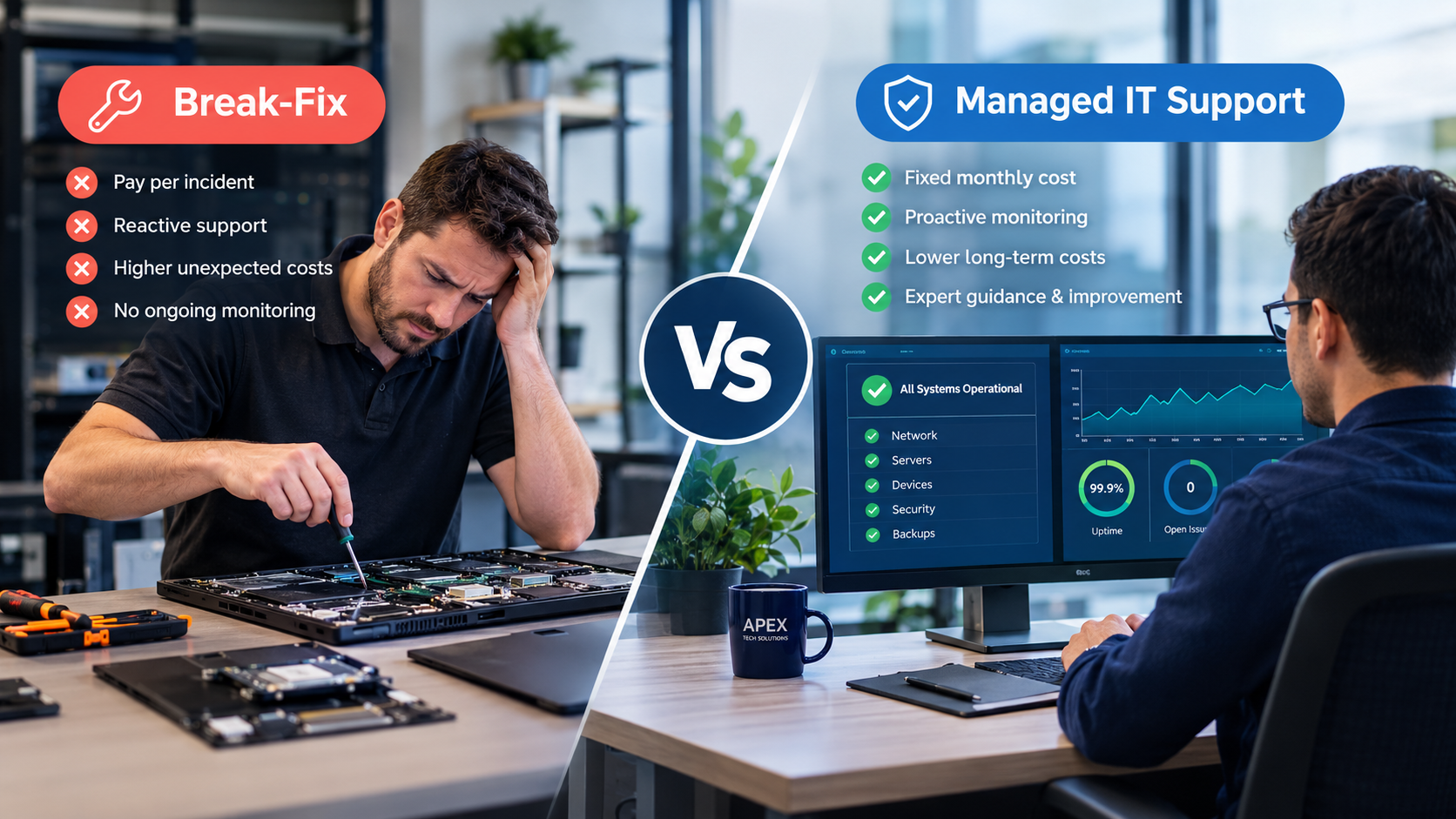
When something breaks, you call someone. That is break-fix IT — and for years it was the default model for small and mid-sized businesses. Managed IT Support works differently: instead of paying per incident, you pay for ongoing ownership of your environment. Neither model is universally right. The question is which one matches how your organisation actually operates.
What break-fix actually costs you
Break-fix looks cheap because the invoice is visible only when something fails. The hidden costs are the ones that do not appear on an invoice: staff downtime, lost productivity, emergency call-out premiums, and the fact that nobody is monitoring the environment between incidents. A failing disk, an expiring certificate or a creeping storage limit all sit quietly until they become an outage.
What Managed IT support changes
Managed support shifts the model from reaction to ownership. That means monitoring, patching, user support, and — critically — someone who understands your environment well enough to advise on what to change next. At Apex, the delivery model is deliberately simple: understand, assess, design, deliver, test and hand over, then support and improve. The “improve” step is what separates Managed support from a ticket queue.
Where break-fix still makes sense
If your technology footprint is genuinely small — a handful of devices, no server infrastructure, no compliance pressure — break-fix can be rational. The same applies to a one-off project where you need specialist installation, not ongoing management. The mistake is choosing break-fix for a complex environment simply because the monthly cost is easier to ignore.
The hybrid reality most businesses land on
Most organisations end up somewhere in between: managed support for the core environment, project-based delivery for upgrades and migrations, and consultancy when a decision has real commercial weight. This is why Apex frames its capability as “one partner for ongoing IT and technology projects” rather than a single product.
How to decide
Ask three questions:
- What happens if this system fails on a Friday afternoon? If the answer involves significant operational damage, you need ownership, not a call-out.
- Who currently knows your environment? If the answer is “the person who set it up three years ago and has since left”, that is a risk.
- Are you making technology decisions with evidence? Managed support should produce visibility — asset records, patching status, recurring issue patterns — that informs planning.
Conclusion
Break-fix and managed support are not moral choices; they are commercial models with different risk profiles. The right answer depends on how much your business depends on technology working reliably — and how much uncertainty you are prepared to carry.